
Learn about standard wooden pallet sizes and custom-made options.
Discover the most common wooden pallet sizes and find out when a standard format works best and when a custom pallet makes more sense.
Contents
Why do pallet dimensions matter?
Pallet size affects every step of logistics, from product packing to loading, storage, and final delivery. A well-chosen format helps save space, improves cargo stability, and supports smoother warehouse handling.
That is why many buyers begin with size when asking for a pallet quote.
What are the most common standard pallet sizes?
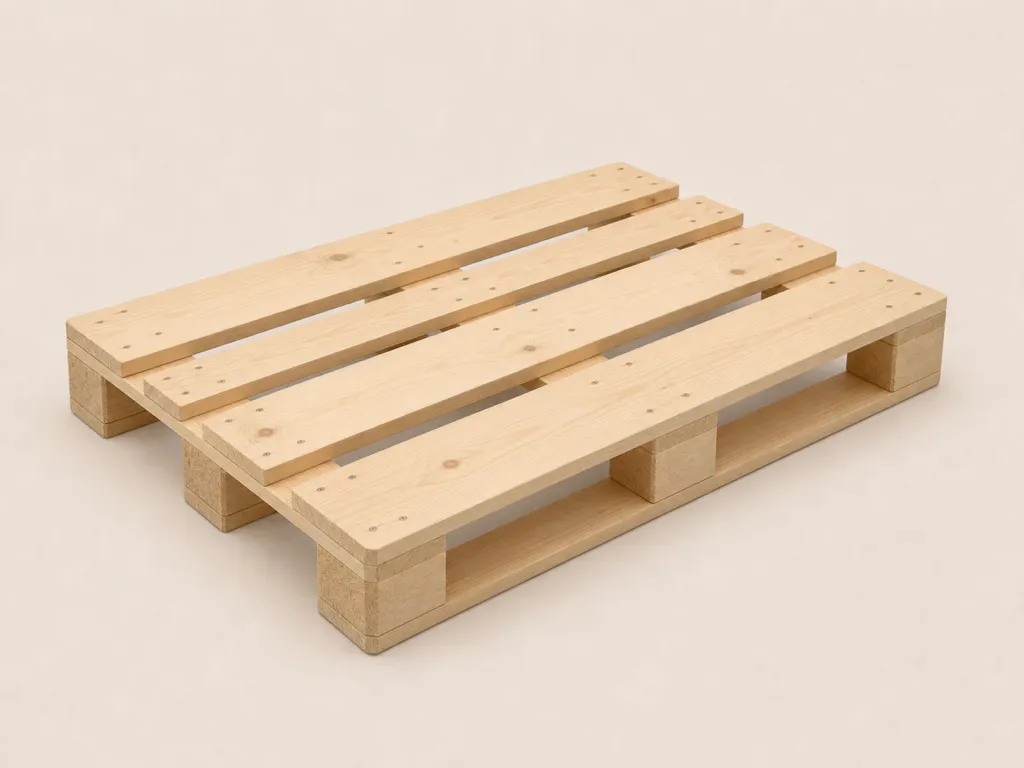
Two of the most common formats are the EURO / EPAL pallet with dimensions of 800 x 1200 mm and the DHP / Düsseldorfer pallet with dimensions of 600 x 800 mm. Both are widely used across European trade, warehousing, and transport.
Standard sizes help simplify logistics because carriers and warehouses already work with these formats.
When should you choose a custom pallet?
A custom pallet makes sense when the product has unusual dimensions or when a standard format does not use transport space efficiently. It is also useful when a business wants better product protection or needs a pallet matched to a specific production process.
Custom solutions are especially relevant for special export projects and non-standard packaging.
What should you include when ordering a pallet?
To select the right format, it is helpful to provide the required length and width, the type of goods, the planned weight, the delivery location, and the target deadline. The more precise the request, the easier it is to recommend a suitable pallet.
A well-described inquiry usually speeds up the quotation process.
FAQ: Common questions about pallet sizes
What are the standard sizes of wooden pallets? The most common sizes are 800 x 1200 mm for EURO / EPAL pallets and 600 x 800 mm for DHP pallets.
Can I order a custom-size pallet? Yes, many companies order pallets tailored to their goods or logistics process.
When is a standard pallet the better option? When fast availability, easy handling, and compatibility with common logistics systems are important.
Is a custom pallet always better? No, it is most useful when the standard size does not fit the product or shipment well.
Quick selection table
- DHP
- 600 x 800 mm / trade, industry, warehouse circulation
- EURO / EPAL
- 800 x 1200 mm / standard logistics
- Export
- one-way pallets when there is no return loop
- Variants
- new, dry IPPC, used, depending on the process
- Enquiry
- type, format, quantity, delivery place, timing
Enquiry checklist
- Share the load format and expected load.
- State whether the pallet must return to circulation.
- Mark if a dry or IPPC variant is required.
- Add delivery location, timing and planned quantity.
Send pallet parameters for pricing.
Type, format, quantity, delivery location, timing and whether the pallet works in export, warehouse circulation or a return loop are enough to start.