
Discover the standard EURO / EPAL pallet in logistics and storage.
Learn the dimensions, load capacity, and applications of EURO / EPAL pallets and why they are a core standard in European logistics.
Contents
What is a EURO / EPAL pallet?
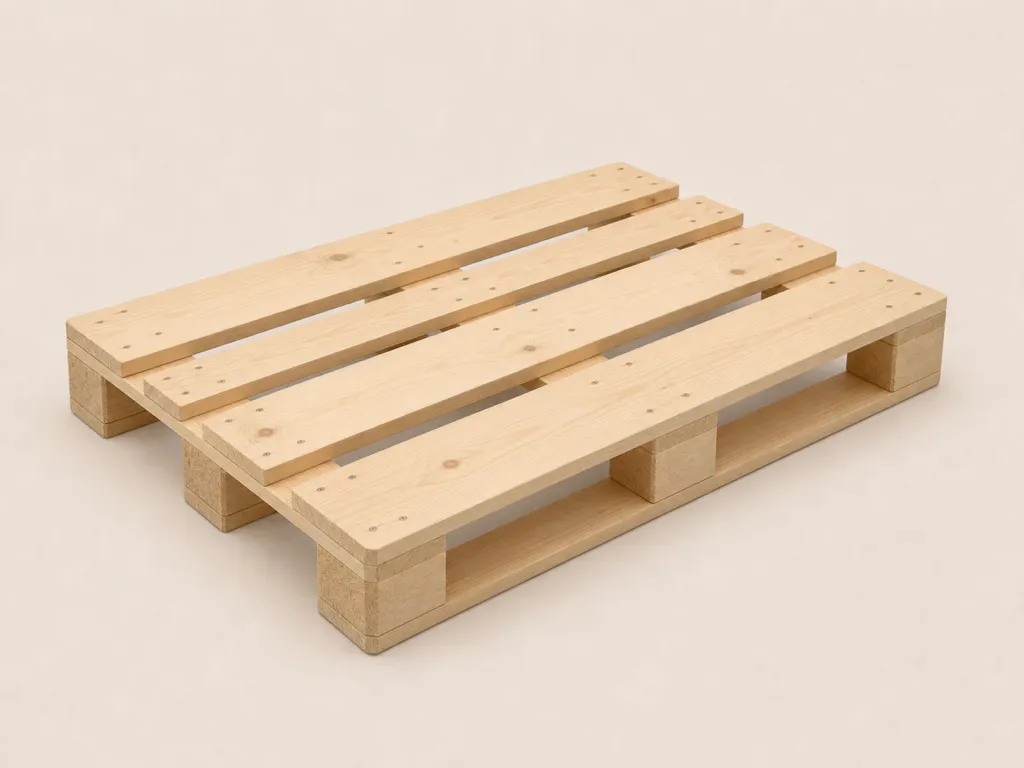
A EURO / EPAL pallet is a flat wooden pallet with the standardized size of 800 x 1200 mm. It is one of the most widely used load carriers in Europe because it supports consistent handling in transport, warehousing, and distribution.
Its standard size makes it easy to integrate with warehouse racks, forklift systems, and truck loading spaces.
What are its dimensions and load capacity?
The standard dimensions of a EURO / EPAL pallet are 800 x 1200 mm. In everyday logistics, its typical working load capacity is around 1200 kg when the weight is evenly distributed.
For many companies, this means simpler load planning and better compatibility with standard logistics processes.
Where is a EURO pallet used most often?
EURO / EPAL pallets are commonly used in warehouses, production plants, wholesale operations, transportation, and retail supply chains. They are a strong choice whenever a business needs a predictable format that works well in repeated handling operations.
This pallet is especially useful in environments where consistency matters more than customization.
Why do companies choose EPAL pallets?
The key advantage is standardization. Buyers, carriers, and warehouses all know what to expect from the format. That reduces friction in loading, unloading, and storage.
For cross-border business within the EU, that predictability is often a major operational benefit.
FAQ: Common questions about EURO / EPAL pallets
What are the dimensions of a EURO pallet? The standard size is 800 x 1200 mm.
What is the load capacity of a EURO pallet? In practice, it is commonly around 1200 kg with proper and even load distribution.
When should I choose a EURO / EPAL pallet? When you need a standard, widely accepted format for transport, storage, and regular logistics operations.
Is a EURO pallet suitable for export? Yes, very often, but for destinations outside the EU you should also verify phytosanitary requirements such as IPPC / ISPM 15.
Quick selection table
- DHP
- 600 x 800 mm / trade, industry, warehouse circulation
- EURO / EPAL
- 800 x 1200 mm / standard logistics
- Export
- one-way pallets when there is no return loop
- Variants
- new, dry IPPC, used, depending on the process
- Enquiry
- type, format, quantity, delivery place, timing
Enquiry checklist
- Share the load format and expected load.
- State whether the pallet must return to circulation.
- Mark if a dry or IPPC variant is required.
- Add delivery location, timing and planned quantity.
Send pallet parameters for pricing.
Type, format, quantity, delivery location, timing and whether the pallet works in export, warehouse circulation or a return loop are enough to start.