
Explore DHP components for pallet production, servicing, and repair.
See which elements are used in DHP pallets and why tubular rivets, metal supports, and plastic supports matter for structural durability.
Contents
Why are DHP components important?
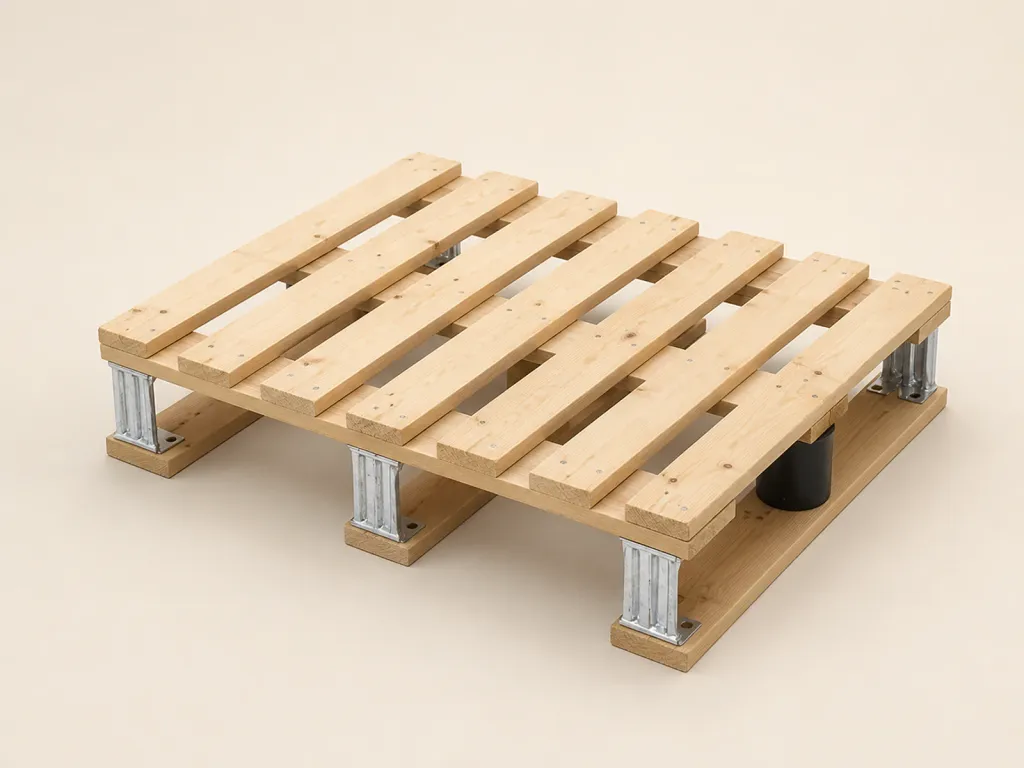
A DHP / Düsseldorfer pallet is not built only from wooden boards. Its durability and repeatability also depend on the elements that connect and support the structure.
For production and repairs, the most important parts include tubular rivets, metal supports, and plastic supports.
What are tubular rivets used for?
Tubular rivets are responsible for joining selected structural elements in a durable way. In practice, they are important for assembling and servicing DHP pallets because they help maintain stability in industrial and retail use.
It is a small detail, but one that has a real effect on pallet strength.
What is the role of metal and plastic supports?
Metal supports help the pallet withstand the practical loads that occur during transport and handling. Plastic supports are also a characteristic part of the DHP structure and work together with the wooden boards and metal elements.
Together, these parts create a compact but functional pallet system.
When are DHP components needed?
These components are used both in the production of new pallets and in repairs or ongoing technical servicing. For companies that rely on the DHP format, quick access to replacement parts helps keep pallets in circulation.
That is especially important in retail and high-turnover logistics environments.
FAQ: Common questions about DHP components
Which components are commonly used in DHP pallets? Tubular rivets, metal supports, and plastic supports are among the most common.
What is a tubular rivet used for? It is used to create durable structural connections in the pallet.
Are DHP components needed for repairs too? Yes, they are used both in production and in pallet servicing and repair.
Why does component quality matter? Because it directly affects durability, safety, and the repeatability of the final pallet structure.
Quick selection table
- DHP
- 600 x 800 mm / trade, industry, warehouse circulation
- EURO / EPAL
- 800 x 1200 mm / standard logistics
- Export
- one-way pallets when there is no return loop
- Variants
- new, dry IPPC, used, depending on the process
- Enquiry
- type, format, quantity, delivery place, timing
Enquiry checklist
- Share the load format and expected load.
- State whether the pallet must return to circulation.
- Mark if a dry or IPPC variant is required.
- Add delivery location, timing and planned quantity.
Send pallet parameters for pricing.
Type, format, quantity, delivery location, timing and whether the pallet works in export, warehouse circulation or a return loop are enough to start.